Rare Earths: History and Definition
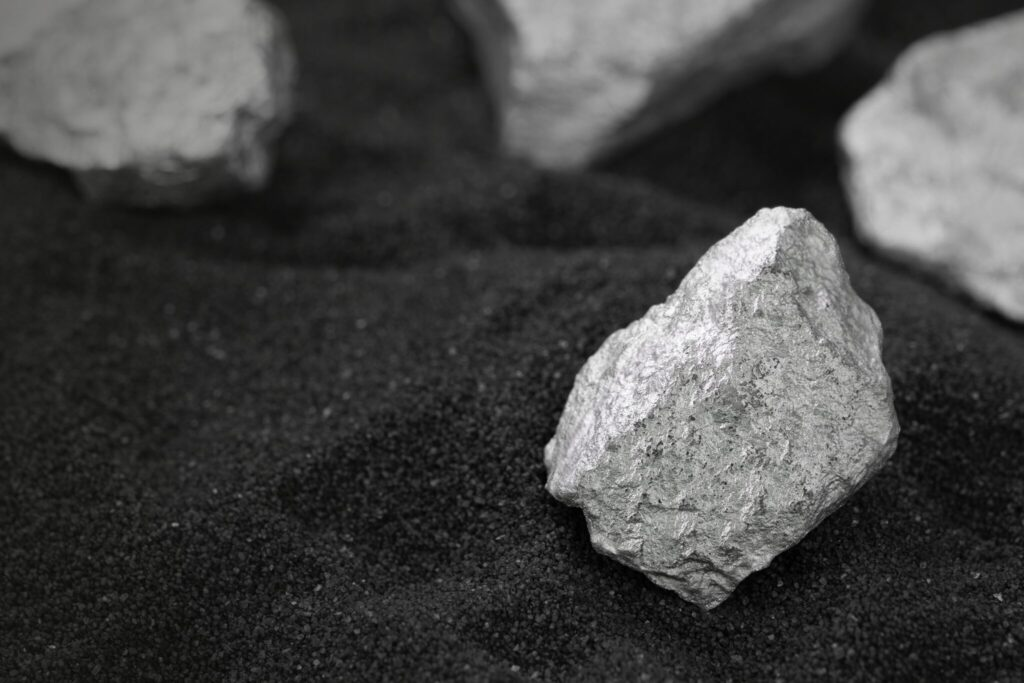
Rare earths, also known as REEs (Rare Earth Elements), are a group of 17 elements that belong to the metal family. Specifically, neodymium, praseodymium, and dysprosium are crucial for the production of permanent magnets. These elements are essential for many applications in the automotive industry, sensor technologies, and clean energy technologies such as wind turbines and electric vehicles.

Despite the name suggesting that these elements are rare, „rare earths“ does not refer to their scarcity on Earth. In fact, the term „rare earths“ was assigned to these elements because of their difficult identification and the complexity of their extraction and processing. Rare earths are never found in pure form like gold or silver but are always mixed with other elements. The first mix of rare earths was discovered in Sweden in 1787 by Swedish chemist Carl Axel Arrhenius. It wasn’t until 1803 that the first rare earth element, cerium, was isolated.
An interesting fact: it is believed that the name „rare earths“ os from Scandinavia, where the discovery of these materials was considered unusual.
The Global Distribution of Rare Earths
Currently, global reserves of rare earths are estimated at about 130 million metric tons. China, with 44 million tons, maintains a dominant position both in production and reserves. Other countries with significant deposits include Brazil, India, Australia, Russia, Vietnam, and the United States. Significant deposits are also found in South Africa, Burundi, and Tanzania. Greenland, which boasts important mineral resources, has reserves of zinc, copper, cobalt, and is particularly rich in rare earths. Here is located the site of Kvanefjeld, which is considered the second-largest rare earth deposit in the world, although extraction has been halted for some time.

The High Concentration of Rare Earths in China
The high concentration of rare earths in China has forced the European Union in recent years to rely entirely on Beijing for the supply of these strategic minerals. However, dependence on a single supplier carries the risk of disruptions due to trade conflicts, geopolitical tensions, or health crises. For this reason, the European Union has placed a strong emphasis on research and development strategies to increase its autonomy in the mining sector.
Major European Deposits: Sweden and Norway
In January 2023, a discovery was made in Kiruna, Swedish Lapland, which was thought to be the largest European rare earth deposit at the time. It contained over 1 million tons of rare earth oxides. However, in June 2024, the Norwegian mining company Rare Earths Norway („REN“) announced a new record-breaking discovery. This deposit, found three years ago in the Fen complex near Oslo, Norway, surpassed the Swedish find in size. Here, near an ancient extinct volcano, it is estimated that there are 8.8 million tons of rare earth oxides—significantly more than in Kiruna. Current exploration is focused on the central part of the site, where an estimated 1.5 million tons of neodymium and praseodymium oxides, used for permanent magnet production, are located.
European Prospects for the Future
The goal for the Norwegian mining company Rare Earths Norway is to create a complete production chain, „from the mine to the magnet.“ With the low environmental impact and highly productive deposits in the Fen complex, it is expected that they could meet 10% of the EU’s demand in the future. This would be a crucial step in reducing the EU’s dependence on China, which is the largest global producer of rare earths. The plan is to begin extraction in 2030, using sustainable extraction and processing technologies that have a minimal environmental impact. As for the Swedish Kiruna site, many preliminary analyses are still being carried out to understand its composition and the deposit. It is also necessary to verify the conditions for extraction, including how to minimize and/or compensate for the environmental impact. Only after analyzing the results can the necessary extraction permits be obtained to begin the mine’s development. This is why extraction cannot be expected before the next ten to fifteen years.
What About Rare Earths in Italy?
Italy has so far been little discussed in the rare earths debate, but the country does have a rich subsoil with strategic resources. According to ISPRA (the Higher Institute for Environmental Protection and Research), Italy is home to 17 chemical elements belonging to the rare earth group. Many deposits, which are now inactive, were once operational but were closed due to high extraction costs. Copper deposits can be found in areas such as the Tuscan and Ligurian-Emilian Apennines, the Western Alps, Trentino, and Sardinia. Manganese was extracted in Liguria and Tuscany, tungsten in Calabria, Sardinia, and the Western Alps, cobalt in Sardinia and Piedmont, and magnesite (or manganese) in Tuscany. There is also the issue of lithium, where Italy has significant quantities in the form of geothermal lithium in the regions of Tuscany, Lazio, and Campania. Reopening these mining sites could represent an opportunity, but it would need to be carefully evaluated in terms of cost, environmental benefits, and the latest exploration technologies.
In conclusion, alongside extraction, it is essential to invest in material recovery and recycling: a necessary step to build a more sustainable and autonomous supply chain. This is equally true for Italy.
Do you have any questions or requests?
Contact our team of experts!
Email: info@mpi.it
Phone: +39 02 93566034
For more information, return to the news section by clicking here.
